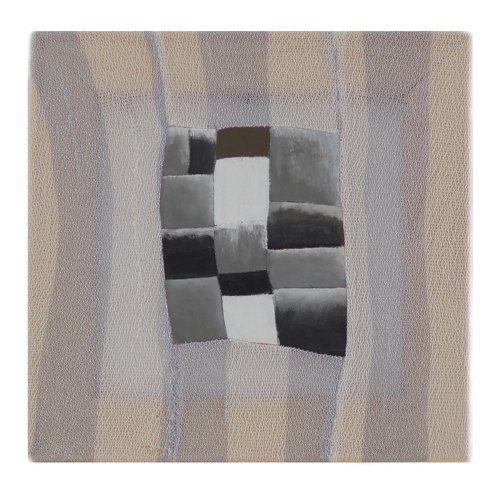
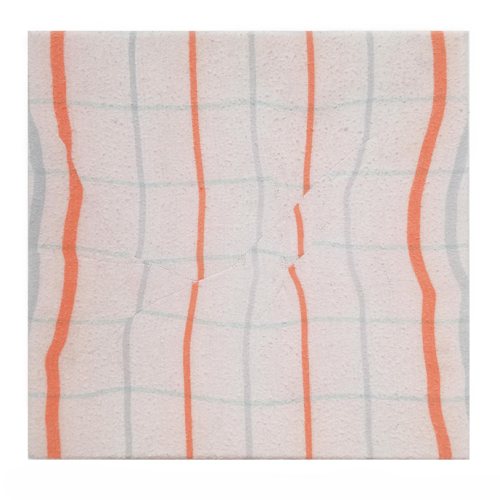
a selection

  • canvas with gauze and band, primer and thread

    Gauze and band | 2018 | gauze, primer and thread | 65 x 45 cm

  • Fifteen pieces of yellow and white acrylic on cotton, and thread

    Fifteen pieces yellow to white gradient | 2022 | 
yellow and white acrylic on cotton, and thread | 75 x 60 cm

  • canvas made with gauze, polyacrylic and thread 75x75 cm

    Gap | 2020 | 
gauze, poly-acrylic and thread | 75×75 cm

  • Used towel on a wooden frame 50x50 cm

    Light gradient | 2020 |used towel | 50×50 cm

  • Canvas with primer on cotton | 30x18 cm

    White stripe | 1990 | primer on cotton | 30×18 cm

  • Tremulous Musings

    In her first solo exhibition at Hidde van Seggelen in Hamburg, Carina Ellemers (*1965, works in Amsterdam) presents recent canvases made of household towels and basic textiles. These Stoffbilder (fabric pictures) often have modest sizes. Her works – light, fine, and sometimes translucent like a spider’s web – evoke strong sensations: that of space (emptiness) for example… The artist selects the fabrics from a large collection of hand-, dust-, and dishcloths and other textiles that she has built up over time. Sometimes one single cloth, because of the visual motif (figuration; abstract pattern), in itself is already a reflection of things that really matter. Such a cloth can be the source of new work; in that case, the artist only has to stretch the material! See e.g. Covered Wagon Red and Blue (2023, [2x] 30×39 cm), a diptych made of two Terschelling-covered wagon towels that belonged to Ellemers’ own family, in which we see a pair of horses pulling a cart traveling to an unknown destination.
    That work evokes the idea of romantic wanderlust – versus (the need for) domestic shelter: the place where we find intimacy. These aspects are evoked by the blue towel’s wear and tear on the one hand and by the fact that the red towel is turned on its back side; this wagon is the negative image. In another work, a serene composition emerges from gauze tissue; this soft form recalls the shape of a curtain dressing a window. The artist saw it as a ‘street scene’ in a split second on her bike. Here textiles transform into an arabesque. The artist: “My towels, dust cloths, or whatever else refer to the ‘not-special’, the everyday you easily overlook, the worn-out that so often elicits the reaction: ‘can go.’ The mundane – nothingness – interests me. Within the mundane, I find and point to the extraordinary. It does not take much to see beauty. It can come to you as an insight into reality, a gentle insight for it does not go against the natural flow.” [1]

    Abstraction and figuration forge new bonds, evoke each other as it were, dance together in Ellemers’ textile works. An abstract composition of hers appears first as a lucid dream from which gradually a vivid Gestalt comes forward – we see the image as it’s taking shape before our eyes. In Gauze Stripe in 8 Pieces (Walk the Line, 2019, 45×32 cm) a road leads through snow-capped hills – in fact, this ‘window-silk’ is from a larger series. The artist made the first one in 1992, stretching cloth across a painting frame, the way a drapery decorates/covers the window. In Gap and Band (2023, 70×50 cm) a shadow caresses the window. 12 yellow towels (rentex, 2023, 145×95 cm) suggests a bucolic scene of crops in a garden. Such brief and, admittedly, quite loose (a bit sentimental) characterisations of visual motifs allude to larger themes: romantic wanderlust (once again) or in other words the lure of landscape; the grace of a natural movement; joy in the earth’s bounties. In these works something essential happens: Ellemers apprehends reality in a poetic way.

    The same thing can be said about two artists that Ellemers, when asked, names as makers who greatly inspired her. She says: “Their work yearns for life.” JCJ Vanderheyden makes connections with history – Vermeer, for example as well as everyday life – as he captures bits of the blue sky in his paintings, photographs or open-air cabins (Vanderheyden was a mentor of Ellemers during her residency at the Rijksakademie, 1990-92). His art evokes a sense of tranquility and open-mindedness.
    Daan van Golden is next: Ellemers saw his work as a child in the Stedelijk Museum. She remembers the postcard of ‘the handkerchief’; long ago already it made an impression. In that meditative painting, made with enamel paint, the dignified tradition of geometric abstraction is set forth in a surprising way. Just after finishing high school, Ellemers also met Van Golden. This was around the time of his public art work at the Heineken Plein in Amsterdam, where he covered a wall of a building with a design of daisy-fabric.
    In this context she also mentions three filmmakers, who in their work give attention to and cherish ordinary situations and events: the Iranian master filmer Abbras Kiarostami depicts the special nature of the everyday with a precise and humane eye; Victor Erice because of El sol del Membrillo (Dream of Light) in which a painter endlessly deliberates on how to depict a quince as accurately as possible while the tree with its gorgeous fruits simply continues to grow; as well as Jasujiro Ozu with his philosophical films about ordinary people, the vicissitudes of family life, his cinematic depictions of tranquility even in the face of adversity, “and his kitchens where women walk in and out, and where on the counter a towel and a scouring pad lie side by side, simple things that last a lifetime…” [2]

    Ellemers’ work has important cultural references. The first one is the modern, aforementioned tradition of geometric abstraction; Piet Mondrian in particular. Ellemers: “Much of the ideas that led to Mondrian’s ‘high abstraction’ probably came about through Jan Toorop (born in the Dutch East Indies, now Indonesia); it is Indonesian in origin. Mondrian meditated, practiced yoga and had a strong interest in theosophy. These Indonesian roots have been partly erased from art history; they interest me deeply.” Her connection with geometric abstraction is strong; it feels like Ellemers’ homeland – am I mistaken, or are her Gap and Band paintings a response to Mondrian’s Pier and Ocean works? Ellemers: “I prefer not to use too much paint. For me, the surface is the most important. I connect my canvas with geometric abstraction, by allowing the thread’s curvature to play the main part, as pure line-work.”
    Folk art is the second reference: in its very depiction of feeling. Vernacular Imagination was essential to Mike Kelley for example; he was genuinely interested in popular expressions and its visual vocabularies. As an advocate of folk art, he stood up for this; his work reflects both the frustration felt by entire groups about others’ disregard of their art, as well as the euphoria and pride belonging to this type of burlesque expression. Such feeling is a (hidden) layer in Ellemers’ work.
    The third reference is a Japanese concept, mono no aware, which expresses a refined, poetic amazement about things. It’s a reflection on the fact that nothing is permanent or rather that everything is transient: each thing is full of meaning in its own way at every single moment. Mono no aware is often translated as ‘the pathos of things,’ ‘empathy towards things’, ‘sensitivity towards ephemera’ – the Dutch 17th-century still life paintings have a similar susceptibility. We also find this soft power in Ellemers’ paintings: her works encourage the viewer to see and experience change. (Just in passing I will mention a fourth reference, namely the appropriation art that came up in the 1980s, particularly in the US. Sherrie Levine was/remains a strong figurehead of a movement in which artists ‘took’ existing objects, cultural concepts, and art works with a respectable place in the modern canon (high art) and made their variations. Often, the objects, concepts, etc. that they worked with came from far away. Yet Ellemers takes things close to home – like the towels with the wagon-motif – and creates a new perspective with them.)

    Ellemers’ working method is unique, even somewhat fairytale-like. Disruption or destruction is almost taboo. Interventions like the addition of paint are kept to a minimum; things are allowed to take their course. Her studio makes me think of a cocoon where canvases and fabrics remain dormant until the moment they are ready to see the day, showing their true, transformed selves. In this process time is of the essence. The design of a canvas or wear and tear of fabric (imprints of ‘past life’) can, as it were, call out to the artist: do something with me! Ellemers: ‘The intention with which you make something is crucial.’ To her, aesthetic and existential motivations are equally important.

    Her work has deep roots. A recent artist’s statement is intriguing: “Shame plays a role. How exactly, I do not know yet.” Then she e-mails me four images: 1. Photo: “Victorian period: a mother, hidden under a cloth for the baby photo.” -This veiled mother is a striking and eerie image! 2. Painting: handkerchief by Daan van Golden: “Daan in search of calmness.” 3. Photo: tea towel woven by Kitty van der Mijll Dekker (“The Bauhaus art school required her to weave like all the other female artists.”) with a delicate grid, a network of lines. 4. “Shame. I roughly edited a photo of three grieving women from the Victorian era. They hide their faces in mourning. In their hands, death certificates.” The artist has accentuated the death tokens – the women are covering their faces with them – with red, yellow, and blue paint dots.
    To me, such critical reflections, and the visual amendment of a historical photo, suggest this: through her art Ellemers is creating a tranquil zone, perhaps to process old grief, and purify wrongdoings. Here a strong power is at work: as a ‘collective unfolding’ behind the artist’s back. This consideration brings me to the ground for Ellemers’ practice: I think it is empathy with all these anonymous women, spinsters, painters and weavers: the makers of quivering textiles. It gives her canvases a surprising topicality.

    Mark Kremer | writer curator | 2023

    [1] Artists quotes and other info from conversations and mails with the author, Summer 2023.

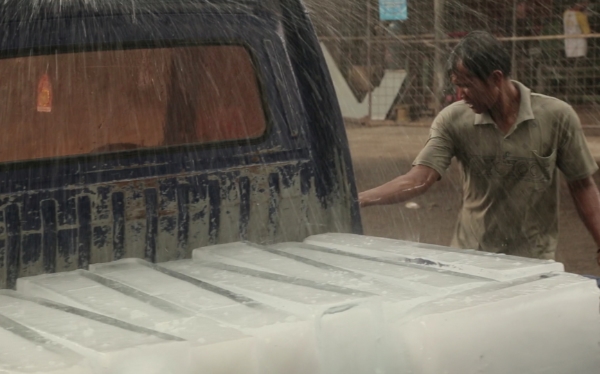
    [2] Ellemers is a filmmaker herself. She recently made Es balok (70’, color, video documentary, 2024) as part of a larger ice project.* “The production and distribution of refrigerated ice is followed in and around a small refrigerated ice factory, an ongoing cyclical 24-hour process, in the town of Klaten, Central Java. It is impressive how quiet and calmly the men are absorbed in their heavy work with the ice blocks. Equally impressive is how the ice gradually evaporates into the ether and the air.” *In 2024, the comprehensive book IJS/ICE (design Lies Ros, text Tijs Goldschmidt, publisher de Buitenkant) appeared. carinaellemers.nl/project-ijs-ice/book/

    (Nederlands)

    Trillende spinsels

    In haar eerste solo show bij Galerie Hidde van Seggelen toont Carina Ellemers (*1965, werkt in Amsterdam) recente schilderijen gemaakt van huishouddoeken en elementaire textielen.  Haar Stoffbilder hebben vaak bescheiden formaten.  De werken – licht, fijn, en soms doorschijnend als een spinneweb – evoceren sterke sensaties: bijvoorbeeld ruimte (leegte).  De kunstenaar kiest de weefsels waarmee ze werkt uit haar in de loop der tijd aangelegde verzameling van hand-, stof- en vaatdoeken en stoffen.  Soms vormt een enkel doek, vanwege een visueel motief (figuratie; abstract patroon) zelf al een soort weerspiegeling van dingen die ertoe doen.  Zo’n doek kan de bron zijn van nieuw werk; de kunstenaar moet dat dan goed opspannen!  Zie Huifkar rood en blauw (2023, [2x] 30×39 cm), een tweeluik gemaakt met Terschellinghuifkar handdoeken die behoorden tot Ellemers’ eigen familie, waarin een span paarden een kar voorttrekken met een familie op reis naar onbekende bestemming.  Dit werk lijkt een verbeelding van Romantische Wanderlust – versus (de behoefte aan) huiselijke beschutting: plek waar intimiteit gedijt.  Die aspecten worden in zekere zin benadrukt door slijtage van de blauwe handdoek en ‘t gegeven dat wij de rode handdoek op de rugzijde zien waardoor de rode huifkar als negatief beeld opdoemt.  In een ander werk ontstaat uit gaas een serene compositie, geënt op de valwijze van een gordijn; de kunstenaar zag dit ‘straatbeeld’ in een fractie van een seconde op de fiets.  De stof transformeert hier in een soort arabesk.  Ellemers: “Mijn handdoeken, stofdoeken of wat ook meer verwijzen naar het ‘niet-bijzondere’, ‘t alledaagse waaraan je voorbij zou lopen, sleetsheid die als reactie oproept: ‘kan weg’.  Dat alledaagse – het net niks – interesseert mij.  Binnen dit alledaagse vind en wijs ik op het bijzondere.  Er is niet veel nodig om schoonheid te zien.  Dit kan tot je komen als een inzicht in de realiteit, een zacht inzicht omdat het niet ingaat tegen de natuurlijke gang.” [1]

    Abstractie en figuratie gaan nieuwe verbanden aan, roepen elkaar als het ware op, dansen samen in Ellemers’ werken.  Een abstracte compositie verschijnt in eerste instantie als een heldere droom, waaruit zich geleidelijk aan een levendige Gestalt losmaakt – voor ogen van de kijker kristalliseert een herkenbaar beeld.  Een weg voert door de met sneeuw bedekte heuvels (Gauze Stripe in 8 Pieces (Walk the Line), 2019, 45×32 cm – feitelijk is dit een ‘raamwerk’ uit een serie waarvan de eerste in 1992 ontstaat: in dit schilderij is een doek over een raam gespannen zoals een gordijn over een kozijn valt); schaduw bestrijkt een raam (Gap and Band, 2023, 70×50 cm); de tuintjes brengen vruchten voort (12 gele handdoeken (rentex), 2023, 145×95 cm).  Deze korte en, toegegeven, wat vrije typeringen van visuele motieven zinspelen op de grotere thema’s die in deze drie werken sluimeren: Romantische Wanderlust (wederom) ofwel de aantrekking van het landschap; de gratie van een natuurlijke beweging; blijdschap over de genereuze aarde.  Hier gebeurt iets essentieels: Ellemers betrapt de werkelijkheid op poëtische wijze.

    Hetzelfde kan gezegd worden over twee kunstenaars die Ellemers, desgevraagd, noemt als makers die haar hebben geïnspireerd.  Zij zegt: ‘Hun kunst rijkhalst naar het leven.’  JCJ Vanderheyden maakt verbindingen met de geschiedenis, Vermeer bijvoorbeeld, en met het leven van alledag wanneer hij stukjes blauwe hemel vangt in zijn schilderijen, foto’s en openlucht kabines (JCJ was begeleider van Ellemers op de Rijksakademie in 1990-92).  Zijn werk maakt verstilling en onbevangenheid voelbaar.  Ellemers leerde het werk van Daan van Golden als kind kennen in het Stedelijk Museum.  Ze herinnert zich de postkaart van ‘de zakdoek’ die toen al sterke indruk maakte.  In dat meditatieve, met emailleverf gemaakte schilderij wordt de traditie van de geometrische abstractie verrassend voortgezet.  Net klaar met het atheneum ontmoette Ellemers Van Golden rond de tijd dat hij een public art work exposeerde op ‘t Heineken Plein in Amsterdam: een wand met margrietjes-stofontwerp.  In deze context noemt zij verder drie filmers die in hun films de aandacht voor situaties en gebeurtenissen koesteren: de Iraanse meester Abbras Kiarostami die met zijn preciese en humane blik het bijzondere van het alledaagse verbeeldt; Victor Erice de regisseur van El sol del Membrillo (Engelse titel Dream of Light) waarin een schilder eindeloos wikt en weegt om een kweepeer zo juist als mogelijk te kunnen schilderen terwijl de boom met prachtige vruchten maar doorgroeit; en Jasujiro Ozu en zijn films over het leven van gewone mensen, de lotgevallen van de familie, zijn verbeelding van rust ook als het tegenzit, en zijn keukens waar vrouwen in en uit lopen en op het aanrecht een handdoekje en schuursponsje naast elkaar liggen, eenvoudige dingen die een heel leven meegaan… [2]

    Ellemers’ werk staat in verband met belangrijke culturele referenties.  De eerste referentie is de al genoemde traditie van de geometrische abstractie, en vooral Piet Mondriaan.  Ellemers: “Veel gedachtegoed dat geleid heeft tot Mondriaans ‘hoge abstractie’ is waarschijnlijk via Jan Toorop (geboren in Nederlands-Indië, nu Indonesië) tot stand gekomen; het is Indonesisch van oorsprong.  Mondriaan mediteerde, deed aan yoga, had een sterke interesse in theosofie.  Deze Indische wortels zijn deels uit de geschiedenis geweerd; mij interesseren ze zeer.”  Deze connectie met de geometrische abstractie is sterk, dit is Ellemers’ homeland: vergis ik me of geven haar Gap and Band schilderijen een antwoord op Mondriaans Pier and Ocean werken?  Ellemers: “Liever gebruik ik niet al te veel verf.  Voor mij is de ondergrond het eerste.  Ik verbind mijn doek met de geometrische abstractie door de welving van de draad als pure lijnvoering mee te laten doen.”

    De tweede referentie is de volkskunst en haar verbeelding van gevoel.  Vernacular Imagination was essentieel voor bijvoorbeeld Mike Kelley die de onderwaardering van de burleske expressie verbeeldt, de frustratie erover van hele groepen, maar ook de euforie en trots over deze eigen uitdrukkingswijze.  Ellemers’ werk heeft een verborgen laag die hiermee verband houdt (ik kom hierop terug). 

    De derde referentie is een Japans begrip, mono no aware, waarmee geraffineerde verbazing over dingen wordt uitgedrukt, poëtische bespiegeling op het gegeven dat niets permanent is, oftewel dat alles vergankelijk is, maar dat elk ding op elk moment op zijn manier vol van betekenis is.  Mono no aware wordt wel vertaald als ‘the pathos of things’, ‘an empathy towards things’, of ‘a sensitivity towards ephemera’ (onze 17de eeuwse stillevens weerspiegelen een enigszins vergelijkbare gevoeligheid).  Al die dingen vinden we ook bij Ellemers: haar werken wekken de kijker op om de veranderlijkheid te zien en te betrachten. 

    (Een vierde referentie die ik alleen aanstip is de appropriation art die in de jaren ’80 vooral in de V.S. opkwam; Sherrie Levine was en blijft een sterke representant van een stroming waarin kunstenaars ready made objecten, culturele begrippen of werken met een respectabele plaats in de moderne kunstcanon [high art] ‘namen’ en hierop varieerden.  Vaak kwamen die voorwerpen, noties etc. van ‘ver weg’.  Ellemers neemt dingen dichtbij huis – zoals de handdoeken met huifkarmotief – en creëert een nieuw gezichtspunt.)

    Ellemers’ werkwijze is apart, zelfs ietwat sprookjesachtig.  Verstoring (destructie) is bijna taboe, er wordt vaak zo weinig mogelijk ingegrepen, dingen moeten hun eigen beloop hebben.  Haar atelier doet denken aan een cocon waar doeken en stoffen in een doezel verkeren tot het moment dat ze transformeren en hun ware gelaat open gaat.  Tijd speelt een grote rol in het proces.  Het ontwerp van een doek of de sleetsheid van stof (als afdruk van ‘voorbij leven’) kan de kunstenaar als het ware toeroepen: doe iets met mij!  Ellemers: “De intentie waarmee je iets maakt, dat is cruciaal.”  Esthetische en existentiële drijfveren zijn voor haar even belangrijk.  Ellemers werken hebben diepe gronden.  Intrigerend is haar recente uitspraak: “Schaamte speelt een rol.  Hoe precies, ik weet ‘t nog niet.”  Ze stuurt me een e-mail met beelden: 1. “Victoriaanse tijd: een voor de babyfoto verhulde moeder onder doek.”  De versluierde moeder, indrukwekkend beeld, griezelig ook!  2. Schilderij: zakdoek van Daan van Golden: “Daan op zoek naar kalmte.”  3. Theedoek geweven door Kitty van der Mijll Dekker (“zij moest weven van het Bauhaus zoals alle vrouwelijke kunstenaars”) met fijn lijnengrid.  4.  “Shame.  Een door mij schetsmatig bewerkte foto van drie rouwende vrouwen, Victoriaanse tijd.  Ze verschuilen het gezicht in rouw.  In hun hand overlijdensdocumenten.”  De rouwbrieven waarmee de vrouwen hun gezicht afdekken zijn door Ellemers rood, geel en blauw gemaakt.  Zulke overwegingen geven het idee dat Ellemers met haar schilderijen een soort stiltezone creëert, om oud verdriet te verwerken, loutering te ondergaan.  Die kracht is sterk: een collectief gebeuren voltrekt zich, achter de rug van de kunstenaar om.  De ondergrond van dit werk: ik denk dat het empathie is met al die anonieme vrouwen, spinsters, schilders en weefsters, de makers van mooie doeken.  Dit geeft haar doeken een verrassende actualiteit.

    Mark Kremer | schrijver curator | 2023

    [1] Kunstenaarscitaten en info afkomstig uit gesprekken en mails met de auteur, zomer 2023.

    [2] Ellemers is zelf ook filmmaker.  Recentelijk maakte zij Es balok (70 minuten, kleur, video documentaire, 2023) als onderdeel van een groter ijs-project (het boek IJs, vormgeving Lies Ros, voorwoord Tijs Goldschmidt, verschijnt binnenkort).  “Koelijsproductie en distributie wordt in en om een kleine koelijsfabriek, als een continuerend cyclisch 24-uurs proces, in de stad Klaten op midden Java gevolgd.  Zo indrukwekkend stil en kalm als de mannen opgaan in het zware werk met de ijsblokken, zo verdampt het ijs geleidelijk in de ether en de lucht.”

  • As an artist, those who choose to limit their means will discover more and more possibilities within them. Carina Ellemers (1965) is a painter without paint. That is not entirely true, for now and then she does apply a little paint to her canvases, but more to emphasize that the canvas can do without it. You can hardly catch her making pictures. That is not to say that her work is abstract. As a material, the canvas is primarily what it is and thus a confirmation of what we see. At the same time, as a painting it is a negation of what we think we perceive. It is always more than that. She practices a form of painting where she gets the most out of the least possible.

    Alex de Vries | writer curator
    Studio Visit: Carina Ellemers – A painter without paint | Mister Motley Sept. 23, 2019

  • striped satin, thread and primer on a wooden frame | 80x65 cm

    Band and white stripes | 2019 | striped satin, thread and primer | 80×65 cm

  • Yellow and white acrylic on French antique sheet, cotton, thread on a wooden frame | 65x50 cm

    Yellow gradients in cotton | yellow and white acrylic on French antique sheet, cotton, thread | 65×50

  • primer and acrylic on jute, thread on a wooden frame 60x40 cm

    Band and pleat | 2023 | primer and acrylic on jute, thread | 60×40 cm

  • gold-metal on cotton, gauze, thread on a wooden frame 30x25 cm

    Golden bar | 2016 | gold-metal on cotton, gauze, thread | 30×25 cm

  • Carina Ellemers’ work moves between the world of tactility and caressability, on the one hand, and that of cool abstraction, on the other. We see that the often shiny fabrics have a warm appearance. From a distance, if you are not already familiar with her work, you have no idea that it is made of fabric. That it is composed of small pieces, often of the same fabric, stitched together and pulled around a muslin frame creating a twist in the fabric. They are no longer neat little squares, but squares and angled rectangles. To make it even more confusing, some of the works are painted, but in such a way that even the paint looks velvety. Carina manages to apply different media in such a way that it falls within a long Dutch tradition of abstract art, but is innovative in its use of materials. Carina has found a way to make cool abstraction seductive and sensual.

    Diana Wind | formerly director Stedelijk Museum Schiedam

  • Studies for a simpler life.

    How sensual can a painted square be? In the case of Carina Ellemers: very much so. Her geometric forms have a materiality you want to touch.

    … For Ellemers, a painting is a window on the world. Like paintings were before we had photography, television or computer screens. Sometimes that is very literal and you can actually see through it. Her paintings on cheesecloth are transparent like a voile. The cross on the back of the stretcher is visible but so is the wall behind it. Both become part of the image, with irregularities, bumps and knots and all.

    The painter is originally a filmmaker. That past resonates in her choice of words. When she talks about composition, she says “framing. And for her, painting equals editing.

    What she arranges and rearranges on her canvases are geometric patterns. In that, she does follow Mondrian. She stands in an abstract minimalist tradition. With a black square, she winks at Malevich’s absolute zero. Her patterns that resemble household textiles call to mind the work of Daan van Golden. But with Ellemers, the squares, stripes or even a crack – simple, small representations – take on something earthy and sensual. For they are not only flat but also surface. And you have to control yourself as a viewer not to stroke them for a moment.

    That tactile quality is a consequence of Ellemers’ working method. She stretches and stretches the canvas on the stretcher until the material begins to ‘speak’. Sometimes she takes it off again and stretches it in a different way. The painting is massaged to life, as it were.

    In the past, these works could sometimes be quite large, up to two by two and a half meters. Lately, the sizes are much more modest. …Her new paintings are studies for a simpler, lighter life….­­­

    Edo Dijksterhuis | journalist
    Parool 2018

  • Yellow primer and acrylic on cotton on a wooden frame | 65x55 cm

    White net on yellow | 2021 | primer and acrylic on cotton | 65×55 cm

  • primer on gauze, thread on wooden frame 42,5x32 cm

    Sixteen pieces (white gradient) | 2019 | primer on gauze, thread | 42,5×32 cm

  • towel, cotton, thread on wooden frame 35x35 cm

    Four pink stripes | 2020 | towel, cotton, thread | 35×35 cm

  • gold-metal and adhesive on gesso on gauze on a wooden frame 65x55 cm

    Track | 2016 – 2023 | gold-metal and adhesive on gesso on gauze | 65×55 cm

  • “There is a nakedness about this art, something is exposed to the bone. Their sensations of animated form may suggest otherwise… Before our eyes we see fabrics (a product of craft and spirit) undergo infinity small mutations. Ellemers’ art touches the point where material becomes spirit.

    Mark Kremer | writer curator
    Abstraction and intimacy | publication HIDDE VAN SEGGELEN | March 2021

  • cotton, grey and white acrylic and thread on a wooden frame 58x48 cm

    Striped outlined | 2021 | cotton, grey and white acrylic and thread | 58×48 cm

  • pink acrylic, cotton, thread 100x75 cm

    49 rectangles | 2000 | pink acrylic, cotton, thread | 100×75 cm

  • gauze, tea towel, thread on wooden frame 45x35 cm

    Green grid pink grid “Dank Zeeman, Förg” | 2019 | gauze, tea towel, thread | 45×35 cm

  • sewn striped polyacrylic, gauze and transparent primer o wooden frame 75x75 cm

    Gap and shade-band | 2020 | sewn striped polyacrylic, gauze and transparent primer | 75×75 cm

  • sewn linen and cotton with gold metal on a wooden frame 30x25 cm

    Seamlines drawing | 2015 | sewn linen and cotton with gold metal | 30×25 cm

  • Seamlines drawing is a cloth, canvas, that is firmly painted with gold leaf paint, but in such a way that the structure of the yarn and the texture of the fabric are still visible. Carina has cut the cloth into pieces, into rectangles and squares and sewn them together in a different order, stitched, in order to then stretch the cloth more tightly over the frame. The gold reminds me of icons – although the image of Christ, Mary, angels and/or saints is missing.

    What is emphasized is the beauty of the cloth itself. – it has been freed from its serving and supporting function and is allowed to shine as itself. The rhythmic and yet irregular play of lines of the stitching gives the work relief, deepens and strengthens the gold, there is a play of roughness and shine of canvas fabric and the gold particles on and in it (…) the works moved me immediately, with the green cloth I thought I was looking into my own soul for a moment, but the gold cloth was immediately more objective, more sublime and more connected to what I would like to call ‘truth’. A ‘sacred’ truth about the nature not of the manes, but of each individual.

    Désanne van Brederode | writer philosopher

  • dustrag on a wooden frame 30x25 cm

    Dustrag | 2016 | dustrag 30×25 cm

  • Twelve red blocks in blue checks made with terry, tea towel and thread on a wooden frame 40x35 cm

    Twelve red blocks in blue checks | 2023 | terry, tea towel and thread | 40×35 cm

  • Painted blue in red and white lining made with primer and acrylic on cotton, tea towel on a wooden frame

    Painted blue in red and white lining | 2021-2023 | primer and acrylic on cotton, tea towel | 95×65 cm

  • 384 blocks made with blue gloss acrylic, creamwhite velvet, thread on a wooden frame 140x140 cm

    384 blocks (continuum) | 1995 | blue gloss acrylic, creamwhite velvet, thread | 140×140 cm

  • primer on canvas, thread on a wooden frame 95x75 cm

    Band in window | 1992 | primer on canvas, thread | 95×75 cm

  • Three blue blocks. sewn cotton and felt on a wooden frame 140x140 cm

    Three blue blocks | 2006 | sewn cotton and felt | 140×140 cm

  • Twelve vertical red stripes made with used towel, gauze and thread on a wooden frame 80x65 cm

    Twelve red stripes | 2002| used towel, gauze and thread | 80×65 cm

  • Red line, white line, red rectangle made of canvas and washcloth on a wooden frame 30x25 cm

    Red line, white line, red rectangle | 2012 | canvas and washcloth | 30×25 cm

  • Three white velvet rectangles made with blue gloss acrylic on canvas and cream-white velvet, thread on wooden canvas 25x18 cm

    Three white velvet rectangles | 1994 | blue gloss acrylic on canvas, cream-white velvet, thread | 25×18 cm

  • four pieces black and white made with gauze, towel and thread on a wooden frame 70x50 cm

    Gap and band (four pieces black and white) | 2023 | gauze, towel, thread | 70×50 cm

  • Ten golden fingerprints made with cotton, red cotton square in middle with skullprint, goldpaint and thread on a wooden frame 30x25 cm

    Ten golden fingerprints | 2009 | cotton, red cotton with skullprint, goldpaint, thread | 30×25 cm

  • Twelve rows of squares made with blue gloss acrylic on canvas and thread on a wooden frame 18x18 cm

    Twelve rows of squares (continuum) | 1994 | blue gloss acrylic on canvas, thread | 18×18 cm